
The Hidden Costs of FPGA Toolchain and IP Lock-In | Xlera Solutions

Jesse Beeson
Why your FPGA vendor choice is a 10-year business decision, not just a technical one
The FPGA vendor decision feels like a purely technical choice. You compare datasheets, evaluate performance, download the free development tools, and start designing. It seems straightforward. But fast forward five years. You're now facing a mandatory—and expensive—toolchain upgrade, your critical IP is locked to a platform that's nearing end-of-life, and a new competitor is shipping a similar product on cheaper, more modern silicon. You're trapped.
This is the slow, creeping crisis of toolchain and IP lock-in. It is the third critical inflection point where promising, profitable FPGA programs are quietly derailed by decisions made years earlier. This article will teach you how to see past the initial convenience of vendor ecosystems, calculate the true total cost of ownership, and make a strategic vendor decision that serves your business for the next decade, not just the next quarter.
The Seductive Simplicity of Vendor Ecosystems
When starting a new FPGA project, the path of least resistance is incredibly tempting. The major FPGA vendors have cultivated powerful, all-encompassing ecosystems designed to make your life easy. They offer integrated toolchains, vast libraries of pre-built and optimized IP cores, and extensive reference designs. It feels like a one-stop shop for everything you need to get your project off the ground quickly.
This convenience, however, is a double-edged sword. By embracing a single vendor's ecosystem, you are implicitly signing a long-term contract that you may not fully understand. The ease of use and initial acceleration come at the cost of future flexibility. Vendor lock-in doesn't happen overnight. It's a gradual process of dependency that begins with the first line of code written in a proprietary tool and solidifies with every piece of vendor-specific IP integrated into your design. It happens slowly, then all at once, and by the time you realize you're trapped, it's often too late.
The vendors, of course, are well aware of this dynamic. Their business model is predicated on it. They invest heavily in creating a seamless, integrated experience precisely because they know that once you are embedded in their ecosystem, the switching costs become prohibitively high. This is not necessarily nefarious—it's simply good business strategy. But as a customer, you need to understand the long-term implications of the short-term convenience you are accepting.
What Toolchain and IP Lock-In Actually Means
Vendor lock-in is not a single problem but a multi-faceted issue that can be broken down into three distinct dimensions:
Toolchain Lock-In: This is the most common form of lock-in, where your entire development process is dependent on a vendor's proprietary software suite for synthesis, place-and-route, simulation, and debugging. These tools are often incompatible with other vendors' silicon, effectively tying your design to a single hardware platform.
IP Lock-In: This occurs when you license and integrate IP cores (e.g., PCIe controllers, DDR memory interfaces, complex DSP blocks) that are specifically designed for and encrypted to a single vendor's FPGA family. Porting this IP to another platform is often legally prohibited or technically impossible without a complete redesign.
Ecosystem Lock-In: This is the most subtle but pervasive form of lock-in. It encompasses the skills, workflows, and institutional knowledge your team develops around a specific vendor's ecosystem. Over time, your team becomes so specialized in one vendor's tools and architecture that the prospect of switching becomes organizationally and culturally daunting.
The lifecycle of lock-in often follows a predictable pattern. In year one, the team is thrilled with the vendor's tools and support. By year three, the annual license fees are increasing, but the team is too committed to the platform to consider a change. By year five, you realize you cannot switch to a more cost-effective competitor without a multi-million dollar redesign effort. By year ten, you may find yourself paying a significant premium for legacy silicon simply because you are locked into an architecture that was chosen a decade earlier.
The Hidden Costs: Beyond License Fees
The most dangerous aspect of vendor lock-in is that the true costs are often hidden, appearing years after the initial decision was made. While the annual license fees are the most visible expense, they are often just the tip of the iceberg.
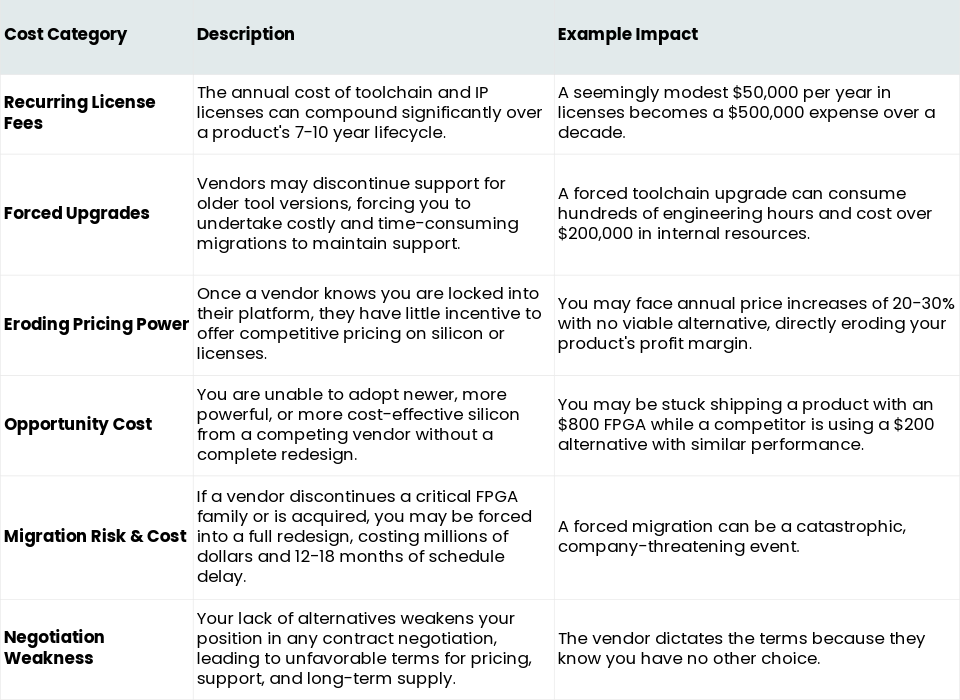
When you sum these hidden costs over a typical product lifecycle, the initial savings from "free" or low-cost tools can easily balloon into a multi-million dollar tax on your product line.
The Four Types of Lock-In (And Which Ones Matter Most)
Not all forms of lock-in carry the same level of risk. Understanding the different types can help you make more informed strategic decisions.
Type 1: Soft Lock-In (Manageable): This is the lock-in that comes from team familiarity and the learning curve associated with new tools. While it can create resistance to change, it is a manageable risk that can be overcome with training and a clear strategic mandate.
Type 2: IP Lock-In (Moderate Risk): This is a more significant risk, as licensed IP cores are often a black box that cannot be easily replaced. However, if the IP is a standard block (like a PCIe controller), it can often be replaced with an equivalent from another vendor, albeit with a significant engineering effort.
Type 3: Toolchain Lock-In (High Risk): This is where the risks begin to escalate. When your entire design methodology is built around a proprietary toolchain, it becomes very difficult to maintain flexibility. Vendor-specific HDL extensions and tool features can embed themselves deep within your design, making portability a major challenge.
Type 4: Architecture Lock-In (Critical Risk): This is the most dangerous form of lock-in. It occurs when your product's fundamental architecture is dependent on a vendor-specific feature, such as the ARM processor cores in a Xilinx Zynq or the Hard Processor System (HPS) in an Intel SoC FPGA. In these cases, migration to another vendor is not just difficult; it is often technically and commercially infeasible.
When Lock-In Becomes a Commercial Crisis
The strategic risks of lock-in often manifest as sudden commercial crises years after the initial technical decisions were made.
Scenario 1: The Vendor Discontinues Your FPGA. Many commercial and defense products have lifecycles of 10, 15, or even 20 years. However, the FPGA you designed in may be declared End-of-Life (EOL) in year five, forcing you into an unplanned and unfunded migration effort just to keep your product shipping.
Scenario 2: A Competitor Ships on Cheaper Silicon. You may be locked into an $800 high-end FPGA, while a nimble competitor designs a solution with a $200 mid-range FPGA that is "good enough" for the target market. Suddenly, your product is no longer cost-competitive, and your market share is at risk.
Scenario 3: The Vendor Aggressively Raises Prices. Your vendor, aware of your dependency, raises annual license fees by 25% and silicon prices by 30%. With no alternative, you are forced to accept the price hikes, directly impacting your profitability.
Scenario 4: A New Market Opportunity Requires a Different Platform. Your original product was designed for the high-performance aerospace market, but you identify a new, high-volume opportunity in the industrial sector that requires a low-cost, low-power FPGA. Because your design is not portable, you are unable to address this new market, and the opportunity is lost.
How to Evaluate Lock-In Risk Before You Commit
The key to avoiding a lock-in crisis is to evaluate the risk before you commit to a platform. This requires a shift from a purely technical evaluation to a strategic, long-term business analysis. The central tool for this is the 10-Year Total Cost of Ownership (TCO) calculation:
Initial Development Cost + (Annual License & Maintenance Fees × Product Lifetime) + Estimated Forced Migration Risk (Probability × Cost) + Opportunity Cost of Lost Vendor Flexibility = True Total Cost of Ownership
This calculation forces you to look beyond the initial license fees and consider the long-term financial implications of your decision. It requires asking critical business questions at the beginning of the project:
Product Lifecycle: How long do we expect this product to be in production and generating revenue?
Volume Projections: Will we be shipping hundreds of units, or hundreds of thousands? The impact of silicon pricing is vastly different at scale.
Market Dynamics: Is this a cost-sensitive market with stable pricing, or a volatile market where silicon prices can change rapidly?
Vendor Stability and Roadmap: How confident are we that this vendor and this specific FPGA family will be supported for the entire lifecycle of our product?
Platform Strategy: Is this a one-off product, or is it intended to be a platform for a whole family of future products? The strategic importance of portability is much higher for a platform.
Strategies to Minimize Lock-In Risk
While it's impossible to eliminate lock-in risk entirely, there are several powerful strategies you can employ to mitigate it.
Design for Portability: This is the most effective strategy. It involves writing clean, standard VHDL or Verilog, avoiding vendor-specific language extensions, and abstracting vendor-specific IP cores behind well-defined interfaces. This creates a layer of insulation between your core design and the vendor's hardware. While it requires more discipline upfront, it pays enormous dividends in the long run by preserving your strategic flexibility.
Evaluate Open-Source Alternatives: For less complex designs, open-source toolchains like Yosys and nextpnr can be a viable way to reduce license costs and eliminate vendor dependency. While these tools may be less mature than their commercial counterparts, they are rapidly improving and can be a powerful option for the right application. They are particularly attractive for high-volume, cost-sensitive products where license fees can significantly impact unit economics.
Conduct a Rigorous Build vs. Buy Analysis for IP: For critical IP blocks that are central to your product's value proposition, consider developing them in-house. While this requires a higher upfront investment, it provides you with a portable, vendor-agnostic asset that you control. This is especially important for IP that is unique to your application or that represents a competitive differentiator.
Negotiate Proactive, Long-Term Contracts: Don't just accept the standard licensing agreement. Negotiate multi-year contracts that lock in pricing for the expected lifetime of your product. Insist on clauses that guarantee long-term supply and provide support for migration if a part is discontinued. A well-negotiated contract can provide significant protection against the most common lock-in risks.
Maintain Dual-Vendor Capability: For mission-critical platform products, the ultimate insurance policy is to design an architecture that can target FPGAs from two different vendors. This requires a significant upfront investment but provides the ultimate strategic flexibility and negotiating power. When a vendor knows you have a viable alternative, your ability to negotiate favorable terms improves dramatically.
When Lock-In Is Acceptable (And When It's Not)
Not all lock-in is bad. In some contexts, the benefits of a tightly integrated vendor ecosystem can outweigh the risks.
Lock-in is generally acceptable when:
The product has a short lifecycle (1-3 years).
Production volumes are low (< 1,000 units).
A vendor-specific feature (like an integrated ARM core) is a critical differentiator for your product.
Time-to-market is the single most important business driver, and the vendor's ecosystem provides the fastest path.
Lock-in becomes dangerous when:
The product has a long lifecycle (7-10+ years).
Production volumes are high (10,000+ units), making the product highly sensitive to silicon cost.
The market is cost-competitive with thin profit margins.
The long-term stability or roadmap of the vendor is uncertain.
The Xlera Approach: Strategic Vendor Independence
At Xlera Solutions, we treat the FPGA vendor decision as one of the most critical strategic business decisions in a product's lifecycle. We work with our clients to evaluate lock-in risk from day one, designing for portability and developing a long-term vendor strategy that aligns with their business goals. In one recent engagement, we helped a client redesign their architecture for portability, a move that is projected to save them over $1.2 million in licensing fees and silicon costs over the life of their product by allowing them to switch to a more cost-effective vendor for their next-generation platform.
Conclusion
Your FPGA vendor choice is a 10-year business decision disguised as a short-term technical one. The path of least resistance—embracing a single vendor's ecosystem without a long-term strategy—is a path that often leads to escalating costs, diminished flexibility, and a critical loss of competitive advantage. The "free" or "easy" option today can become a multi-million dollar tax on your product's profitability over its lifetime.
By evaluating lock-in risk with a 10-year TCO mindset, designing for portability, and making conscious, strategic choices about your IP and toolchains, you can maintain control of your product's destiny. Don't wait until you're facing a forced migration or a non-competitive product to think about vendor lock-in. The time to make the right decision is at the beginning, not when it's already too late.
To learn more about all six inflection points and our complete framework for navigating the commercialization gap, download our comprehensive guide, "The Executive Brief: From Concept to Revenue".
Have you calculated the 10-year total cost of ownership of your current FPGA vendor decision?